
The Configuration Confidence Gap: Why Custom Furniture Is Hard to Sell Online
Introduction
Custom furniture gives customers the freedom to choose dimensions, materials, colors, finishes, fabrics, and configurations that match their homes. However, selling customized furniture online comes with a major challenge: customers often struggle to visualize what their final product will actually look like. Unlike a physical showroom, an e-commerce website cannot always provide the same confidence that comes from seeing and touching a finished piece in person. This gap between product configuration and customer confidence can lead to hesitation, abandoned carts, and product returns.
The rise of Furniture AR and interactive 3D visualization is helping furniture brands overcome this challenge. By allowing customers to configure products and visualize them in realistic environments, these technologies make custom furniture shopping more interactive and transparent. Customers can experiment with different options and better understand how their final furniture piece may look in their space before placing an order.
What Is the Configuration Confidence Gap?
The configuration confidence gap occurs when customers can customize a furniture product online but cannot confidently visualize the final result. A shopper may select a sofa fabric, change its color, adjust the size, or add additional sections, but a simple product image may not update realistically enough to show the complete configuration.
This creates uncertainty. Customers may wonder whether the selected color will match their room, whether the dimensions will work in their space, or whether the final configuration will look as expected. The more customization options a product offers, the more important accurate visualization becomes.
Why Custom Furniture Is Difficult to Sell Online
Custom furniture is often a high-value purchase, so customers want to be certain before spending their money. Traditional e-commerce product pages may show a few standard configurations, while the actual product can have dozens or even hundreds of possible combinations. Static photography cannot realistically represent every variation.
Customers also need to consider practical factors such as room size, furniture proportions, layout, and color coordination. Without an interactive visualization tool, shoppers have to imagine the final result themselves. This mental effort can make the buying process complicated and reduce purchase confidence.
How Furniture AR Helps Customers Visualize Custom Furniture
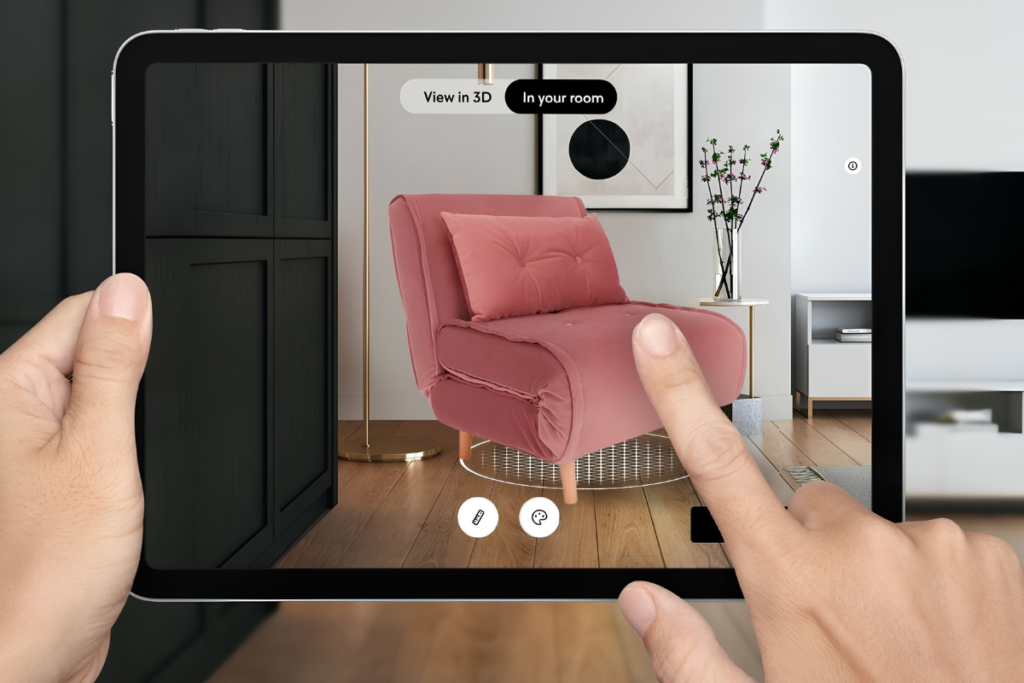
Furniture AR allows customers to place a virtual representation of their configured furniture directly into their room using a smartphone or tablet camera. Instead of imagining how a customized sofa or table might look, customers can see its approximate size, proportions, color, and placement within their actual environment.
This experience becomes even more powerful when AR is combined with a product configurator. Customers can change the furniture’s color, material, size, or configuration and immediately visualize those changes in their space. This makes the customization process easier to understand and gives shoppers greater confidence before ordering.
Interactive Configuration Builds Purchase Confidence
A powerful furniture configurator should not simply allow customers to select options. It should help them understand the impact of every selection. When customers can change upholstery, finishes, dimensions, or layouts and instantly see the updated product, the customization process becomes more intuitive.
This interactive approach reduces uncertainty because customers can evaluate their choices visually rather than relying on descriptions alone. As a result, shoppers are more likely to feel confident about their final configuration and move toward checkout.
Furniture AR Can Reduce Returns
A powerful furniture configurator should not simply allow customers to select options. It should help them understand the impact of every selection. When customers can change upholstery, finishes, dimensions, or layouts and instantly see the updated product, the customization process becomes more intuitive.
This interactive approach reduces uncertainty because customers can evaluate their choices visually rather than relying on descriptions alone. As a result, shoppers are more likely to feel confident about their final configuration and move toward checkout.
Creating a Better Online Showroom Experience
A physical furniture showroom allows customers to walk around products, compare finishes, examine details, and understand scale. Furniture AR can bring some of these experiences into e-commerce.
Customers can explore products from different angles, visualize furniture in their own rooms, and compare multiple configurations without traveling to a showroom. This creates a more immersive digital shopping experience while giving furniture brands the opportunity to reach customers beyond their physical locations.
Benefits for Furniture Brands
Furniture brands can gain several advantages by combining product configuration with AR visualization. A more interactive experience can increase engagement, improve customer confidence, and encourage shoppers to explore premium configurations. When customers understand their options more clearly, they may also be more willing to invest in upgraded materials, larger configurations, or additional features.
The technology can also strengthen brand differentiation. In a competitive furniture e-commerce market, offering an advanced visualization experience can help a brand stand out and provide customers with a more memorable shopping journey.
Best Practices for Implementing Furniture AR
Furniture retailers should focus on creating accurate and realistic 3D models that represent product dimensions, materials, colors, and configurations as closely as possible. The AR experience should be simple enough for customers to use without technical knowledge and should work smoothly across common mobile devices.
It is also important to connect the AR experience directly with the product configurator. When customers change a configuration, the visual representation should update accordingly. This connection creates a seamless journey from customization to visualization and finally to purchase.
The Future of Custom Furniture E-commerce
As e-commerce technology continues to develop, custom furniture shopping will become increasingly visual and interactive. AI-powered recommendations, advanced 3D configurators, realistic material rendering, and Furniture AR will help customers design products that fit their preferences and spaces with greater confidence.
The goal is not simply to make furniture shopping more technologically advanced. It is to remove uncertainty from the buying process and give customers the information they need to make confident decisions.
Conclusion
The configuration confidence gap is one of the biggest challenges facing custom furniture ecommerce. Customers may enjoy having hundreds of customization options, but those choices become difficult when they cannot visualize the final product. Furniture AR, combined with interactive 3D configuration, helps bridge this gap by allowing shoppers to see their customized furniture in a realistic environment before purchasing.
For furniture brands, this technology can improve customer confidence, reduce returns, increase engagement, and create a stronger online showroom experience. As customers increasingly expect personalized and immersive ecommerce experiences, Furniture AR will play an important role in making custom furniture easier and more confident to buy online.
Frequently Asked Questions (FAQs)
1. Why is custom furniture difficult to sell online?
Custom furniture offers many choices like size, fabric, color, material, and configuration. Customers may struggle to visualize the final product, creating uncertainty and reducing purchase confidence.
2. How does Furniture AR help sell custom furniture?
Furniture AR allows customers to visualize customized furniture in their own space. They can see the product’s size, proportions, color, and configuration before placing an order.
3. What is a 3D furniture configurator?
A 3D furniture configurator allows shoppers to customize furniture by changing options such as dimensions, colors, materials, and layouts while viewing the changes in an interactive 3D model.
4. Can Furniture AR reduce custom furniture returns?
Yes. By allowing customers to visualize their selected furniture configuration before purchasing, Furniture AR can reduce mismatched expectations and help lower return rates.
5. Does Furniture AR help customers choose furniture configurations?
Yes. Customers can experiment with different configurations and instantly visualize their choices, making the customization process easier and more engaging.
6. Why should custom furniture brands invest in Furniture AR?
Furniture AR can improve customer confidence, increase engagement, support higher-value purchases, reduce returns, and create a more immersive online furniture shopping experience