
The Modular Layout Puzzle: Why Sectionals Need More Than a Single Product Image
Introduction
Buying a sectional sofa online is very different from buying a simple two-seater or three-seater sofa. A sectional is usually made up of multiple pieces that can be arranged in different ways depending on the room, lifestyle, and available space. Customers may choose an L-shaped configuration, a U-shaped layout, a left-facing chaise, a right-facing chaise, or even separate modules. A single product image rarely communicates all these possibilities clearly. This creates what can be called the modular layout puzzle — customers can see the product, but they cannot always understand how its individual sections will work together in their own room.
For furniture ecommerce brands, this is an important challenge. Customers are not simply asking whether they like the appearance of a sectional. They are trying to understand how the complete configuration will look, whether the arrangement will fit their room, where each module will sit, and whether the final setup will leave enough space for movement. This is where Furniture AR, 3D furniture visualization, and interactive product configuration can make the shopping experience more informative.
What Is the Modular Layout Puzzle?
The modular layout puzzle happens when customers have to mentally assemble a sectional sofa from product images, dimensions, and configuration options. A furniture website may show one attractive setup, while the actual product can be configured in several different ways. The customer has to imagine how changing the chaise position, adding another seat, removing a corner unit, or extending the sofa will affect the overall layout.
This becomes even more difficult when sectional sofas are sold as individual modules. A customer may understand what one piece looks like but still struggle to visualize the complete arrangement. The problem is not necessarily a lack of information. The information may already be available through measurements, diagrams, and product descriptions. The problem is that customers have to convert that information into a mental picture of their own room.
Why a Single Product Image Is Not Enough
A single product image is useful for showing the overall design, upholstery, colour, and styling of a sectional. However, it usually represents only one configuration. If the same sectional can be rearranged into several layouts, the customer may not understand what the other configurations will look like without additional visual support.
For example, imagine a modular sofa that can be purchased with a left chaise or right chaise. The difference may seem small when reading the product description, but it can completely change how the sofa works within a living room. The position of a doorway, television, coffee table, window, or other furniture can determine which configuration makes sense. A static image does not easily communicate these differences.
This is why modern furniture ecommerce needs to move beyond simply showing the product from multiple angles. Customers need to understand the relationship between modules, not just the appearance of the individual pieces.
Modular Furniture Is a Configuration Decision
Sectionals are often configuration-driven products. Customers may select the number of seats, corner units, ottomans, chaises, arm pieces, and other modules before completing their purchase. Each decision can change the dimensions and visual balance of the final sofa.
Traditional ecommerce presentation can make this process complicated. A customer may click through several options and see a different product image each time, but still have difficulty comparing configurations. They may understand that a particular module has a certain width, yet remain unsure about how the complete arrangement will appear in their living space.
An interactive Furniture AR experience can help connect these individual decisions. Instead of treating every module as an isolated product, AR can help customers visualize the assembled configuration within their own environment.
How Furniture AR Helps Solve the Layout Problem
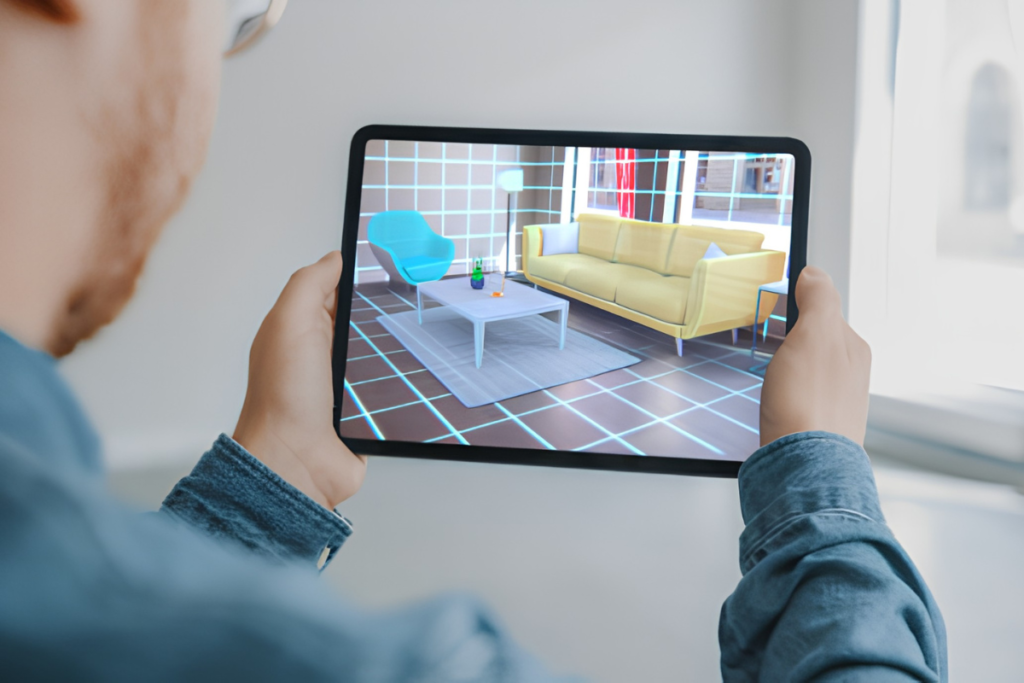
Furniture AR allows shoppers to place a digital version of furniture into their physical environment using a compatible smartphone or device. For modular sectionals, this can become especially valuable because the customer can visualize the sofa at a realistic scale rather than relying only on a product photograph.
When customers can see an L-shaped sectional positioned inside their own living room, they can begin to understand how the configuration relates to the available floor space. If they switch the chaise from one side to another, they can compare the two arrangements visually. If the retailer provides multiple configuration options, shoppers can explore different layouts before deciding which one works best for their space.
This changes the experience from simply looking at a furniture product to actively exploring how the furniture could function inside the home.
3D Furniture Visualization Makes Configurations Easier to Understand
3D furniture visualization can further improve the experience by allowing customers to inspect a sectional from different angles. A three-dimensional model can show the sofa’s structure, individual modules, depth, height, and overall proportions more clearly than a single photograph.
For modular furniture, this is particularly useful because customers can understand how individual pieces connect. Instead of seeing separate product cards for a corner piece, chaise, armless chair, and ottoman, shoppers can view how those components form a complete arrangement.
When combined with a product configurator, 3D visualization can also make the buying process more interactive. Customers can select different modules and immediately see how their configuration changes. This provides a clearer connection between the choices they make and the final product they are purchasing.
Helping Customers Understand Left- and Right-Facing Configurations
One of the most common challenges with sectional sofas is understanding directional configurations. Terms such as left-facing chaise and right-facing chaise can be confusing because customers may interpret them differently depending on how the sofa is viewed.
Visual comparison can reduce this uncertainty. Instead of relying entirely on terminology, customers can see both configurations and understand how the chaise extends from each side. This is especially useful when the sectional needs to fit around existing furniture or architectural features.
With Furniture AR, shoppers can go one step further by placing each configuration into their own room. This allows them to compare not just the sofa itself but also how the configuration interacts with the rest of the space.
Room Fit Goes Beyond Width and Depth
Measurements remain essential when purchasing furniture, but modular sectionals demonstrate why dimensions alone are not enough. A sectional may technically fit within the available width of a room but still create an uncomfortable layout.
For example, the sofa may block part of a walkway, make a doorway harder to access, or leave too little space around a coffee table. A chaise may extend into an area that customers expected to use for movement. These issues are difficult to identify when shoppers only see the sofa against a studio background.
AR visualization gives customers a more practical way to evaluate these relationships. By seeing the sectional within their actual environment, they can better understand the amount of floor space it occupies and how the configuration affects the surrounding area.
Modular Layouts and Customer Confidence
The more expensive and complex a furniture purchase becomes, the more important visual confidence can be. A sectional sofa is often a significant investment, and customers may hesitate if they are unsure whether the chosen configuration will work in their home.
A strong digital visualization experience can reduce some of this uncertainty. Customers can explore configurations, compare layouts, and see how the furniture relates to their room before placing an order. This does not eliminate the need for measurements or product specifications, but it adds an important visual layer to the decision-making process.
For ecommerce brands, this can also create a more engaging product experience. Instead of asking customers to imagine the final result, the website can give them interactive tools that help them explore it.
How Furniture Brands Can Improve Modular Sectional Product Pages
Furniture brands can make sectional product pages more useful by presenting configurations visually instead of depending only on dropdown menus and text labels. Each major configuration should be easy to understand, compare, and explore.
High-quality 3D models can show the furniture from multiple angles, while configuration tools can allow shoppers to add or remove modules. Furniture AR can then bring the selected arrangement into the customer’s room. Together, these technologies can create a smoother path from product discovery to purchase.
Product pages should still provide accurate dimensions, module specifications, material information, delivery details, and care instructions. AR should support this information rather than replace it. The goal is to combine factual product information with realistic visual context.
The Role of AR in Custom Furniture Ecommerce
As furniture ecommerce becomes more customizable, the need for better visualization will continue to grow. Customers increasingly expect to make choices about colour, fabric, dimensions, modules, orientation, and configuration. Each additional choice creates another opportunity for uncertainty if the final result is not clearly visualized.
AR can help make customization easier to understand. When a shopper changes a configuration, the digital model can reflect that change and show the new arrangement. This creates a more connected shopping journey because customers can see the result of their decisions rather than simply reading about them.
For furniture brands selling modular products, this can be especially useful because the product is not one fixed object. It is a collection of components that can become different layouts depending on the customer’s choices.
Reducing the Gap Between Online and In-Store Furniture Shopping
In a physical furniture showroom, customers can walk around a sectional, sit on it, look at it from different angles, and understand how the modules are arranged. They can physically see the relationship between the sofa and the surrounding space.
Online shopping naturally removes much of this physical interaction. Product photography and video can recreate some aspects of the showroom experience, but they still present the product from the retailer’s chosen environment.
Furniture AR introduces another layer by allowing the shopper to place the product into their own environment. This makes the experience more personal because the customer is no longer evaluating the sofa only inside a showroom-style image. They are evaluating how it could look within their own home.
The Future of Modular Sectional Shopping
The future of furniture ecommerce is likely to become increasingly interactive. Instead of selecting a configuration from a simple menu and viewing a static product photograph, customers can explore modular furniture through 3D configurators, AR visualization, room planning tools, and other digital experiences.
For sectional sofas, this could mean creating an entire virtual layout before purchase. Customers could select individual modules, rearrange them, change colours or fabrics, and view the completed sectional inside their room. The result would be a more connected shopping experience where configuration and visualization work together.
The key opportunity for furniture brands is not simply to add AR as a technology feature. It is to use AR to solve a genuine ecommerce problem: helping customers understand what a complex, configurable product will actually look like in their own space.
Conclusion
The modular layout puzzle exists because sectional sofas are more than individual furniture products. They are configurable systems made from multiple components, and customers need to understand how those components work together before making a purchase.
A single product image can communicate design, but it cannot always explain configuration, orientation, room interaction, and real-world placement. Furniture AR, 3D furniture visualization, and interactive configurators can help close this gap by allowing shoppers to explore different arrangements and visualize them within their own environment.
For furniture ecommerce brands, better visualization can make complex sectional products easier to understand. By combining accurate product information with interactive 3D and AR experiences, brands can give customers more context and confidence throughout the online furniture shopping journey.
Frequently Asked Questions (FAQs)
1. Why is layering ima1. Why is a single product image not enough for modular sectionals?portant when buying coats and jackets online?
A single image usually shows only one sectional configuration. Customers may still need to understand different layouts, module combinations, chaise positions, and how the complete sofa will look in their own room.
2. What is the modular layout puzzle in furniture ecommerce?
The modular layout puzzle refers to the difficulty customers face when trying to visualize how separate sectional modules will come together in a specific configuration. Product dimensions and static images may not fully communicate the final arrangement.
3. How does Furniture AR help customers choose a sectional?
Furniture AR allows shoppers to visualize a sectional inside their own room. Customers can better understand the sofa’s scale, orientation, and relationship with surrounding furniture before purchasing.
4. Can 3D furniture visualization show different sectional configurations?
Yes. 3D furniture visualization can display individual modules and complete configurations from different angles. When combined with a configurator, shoppers can explore different arrangements and see how their selections change the final sectional.
5. Can AR help customers choose between left-facing and right-facing sectionals?
Yes. AR can make directional configurations easier to understand by allowing customers to visualize the chaise or extended section on different sides of the sofa and compare how each option works within their room.
6. Does Furniture AR replace furniture measurements?
No. AR should complement accurate measurements, dimensions, and product specifications. It provides visual context while measurements help customers confirm whether the selected configuration can physically fit in their space.