
The Detail Trust Problem: What Fine Jewelry Shoppers Need Before Buying Online
Introduction
Buying fine jewelry online is very different from purchasing an everyday product. Fine jewelry often represents a significant financial investment and may also carry emotional value, especially when customers are shopping for engagement rings, wedding jewelry, heirloom pieces, or special gifts. Before making a purchase, shoppers want to feel confident about every detail, from the quality of the gemstone and metal to the craftsmanship and overall appearance.
The challenge is that traditional e-commerce product pages do not always provide enough information to create this level of confidence. A few product images and written specifications may not fully communicate how a diamond sparkles, how intricate a setting appears, or how a piece of jewelry looks when worn. This creates a detail trust problem for online jewelry retailers. Jewelry AR, 3D visualization, and virtual try-on experiences can help bridge this gap by giving customers a more interactive and transparent way to explore fine jewelry before purchasing.
What Is the Detail Trust Problem?
The detail trust problem occurs when online shoppers cannot fully evaluate the quality and appearance of fine jewelry through standard product listings. In a physical jewelry store, customers can hold a piece, inspect it from different angles, observe its details under different lighting conditions, and try it on.
Online shoppers do not have the same opportunity. They must rely on photographs, videos, descriptions, and technical specifications. Even high-quality images can leave important questions unanswered, making customers uncertain about whether the product will meet their expectations.
Why Fine Jewelry Requires More Customer Confidence
Fine jewelry is often expensive and purchased for important occasions. Because of this, customers typically spend more time researching and comparing products before completing a purchase. They may want to understand the gemstone quality, metal type, dimensions, craftsmanship, and authenticity of the piece.
A lack of information can quickly create hesitation. If customers cannot clearly evaluate a product online, they may postpone their purchase or choose a retailer that provides a more detailed shopping experience.
Why Traditional Product Images Are Not Always Enough
High-resolution photography is important, but static images have limitations. They show a product from selected angles and under controlled lighting. Customers may still struggle to understand the scale, depth, proportions, and intricate design details of a piece.
For example, a ring’s setting may look different when viewed from the side, while a necklace’s pendant may appear larger or smaller depending on the photograph. Fine details such as prongs, engravings, stone placement, and metal texture can also be difficult to evaluate through standard images alone.
How 3D Visualization Builds Detail Trust
Interactive 3D visualization allows customers to explore jewelry from multiple angles. Shoppers can rotate a product, zoom in on specific areas, and examine details that may not be visible in a traditional product gallery.
This creates a more transparent shopping experience because customers have greater control over how they explore the product. Instead of relying entirely on a brand’s selected photographs, shoppers can interact with the jewelry and inspect different aspects independently.
How Jewelry AR Improves Purchase Confidence
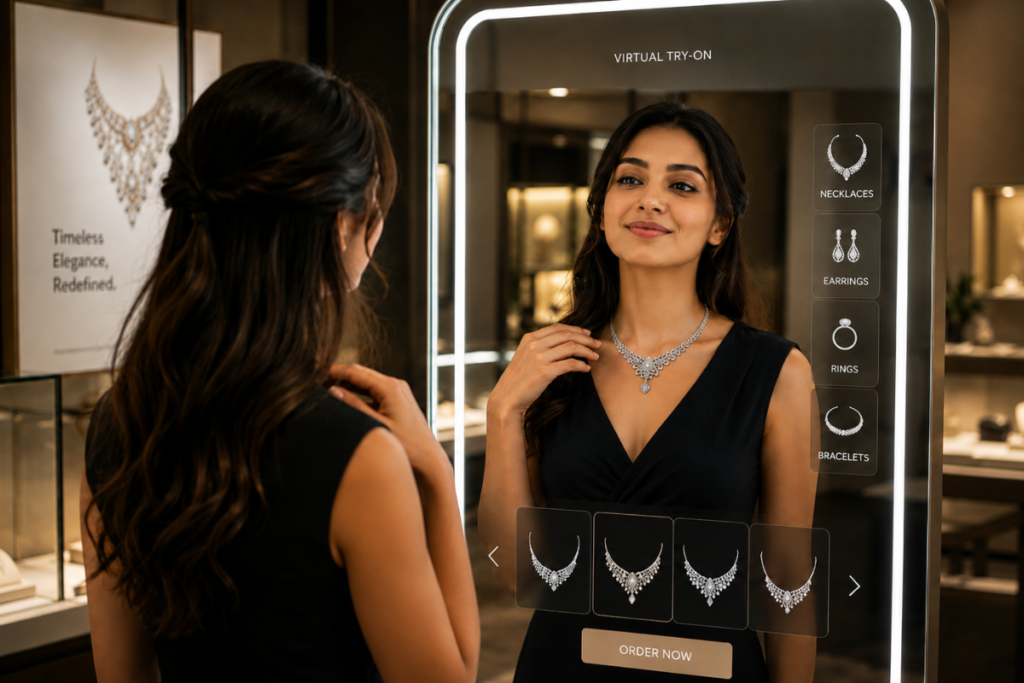
Jewelry AR takes visualization a step further by allowing customers to see how a piece may look when worn. Using augmented reality, shoppers can virtually try on rings, earrings, necklaces, and other jewelry through a compatible device.
This helps answer questions that static images cannot. Customers can better understand proportions, placement, and overall appearance in relation to themselves. When combined with detailed specifications and high-quality product information, Jewelry AR can create a more complete and confidence-building shopping experience.
The Importance of Transparency in Fine Jewelry E-commerce
Technology alone cannot build trust. Fine jewelry brands also need to provide clear and accurate information about their products. Customers should have easy access to details about materials, gemstone characteristics, dimensions, certifications where applicable, and care instructions.
Transparency becomes even more powerful when customers can connect this information with interactive visualization. For example, a customer can read about a gemstone’s characteristics while also exploring the jewelry in 3D and virtually seeing how the piece looks when worn.
What Fine Jewelry Shoppers Need Before Buying Online
Before making a purchase, customers typically need more than a product title and price. A strong online jewelry experience should provide:
- High-quality images and detailed close-ups
- Interactive 3D product visualization
- Virtual jewelry try-on options
- Clear material and gemstone information
- Accurate dimensions and product specifications
- Information about craftsmanship and authenticity
- Transparent return and shipping policies
Providing these details helps reduce uncertainty and gives shoppers the information needed to make confident decisions.
Benefits for Fine Jewelry Brands
Fine jewelry brands that invest in detailed digital experiences can create stronger relationships with online customers. Interactive product visualization encourages shoppers to spend more time exploring products, while transparent information helps establish credibility.
Jewelry AR can also help brands differentiate themselves in a competitive e-commerce market. Instead of asking customers to imagine how a piece will look, retailers can provide an experience that brings the product closer to an in-store interaction.
Creating a Digital Experience That Feels More Personal
Fine jewelry shopping is often emotional and personal. Customers may be selecting a piece to celebrate an engagement, anniversary, birthday, or other meaningful occasion. The online shopping experience should reflect the importance of that decision.
Personalized recommendations, interactive visualization, and virtual try-on can make digital jewelry shopping feel more engaging. These tools help move the experience beyond simply browsing a product catalog and toward a more personal discovery process.
The Future of Fine Jewelry Shopping
As e-commerce technology continues to evolve, customers will expect increasingly detailed and immersive experiences. Jewelry AR, realistic 3D rendering, AI-powered recommendations, and advanced virtual try-on will continue to narrow the gap between online and in-store jewelry shopping.
The future of fine jewelry ecommerce will focus on reducing uncertainty. Brands that help customers understand products clearly, inspect details independently, and visualize jewelry before purchasing will be better positioned to earn long-term customer trust.
Conclusion
The detail trust problem is one of the biggest challenges in fine jewelry ecommerce. Customers are making significant and often emotional purchases, which means standard product images and descriptions may not always be enough. Shoppers need clear information, detailed visualization, and confidence that the product they receive will meet their expectations.
By combining transparency, interactive 3D visualization, and Jewelry AR, fine jewelry brands can create a more informative and engaging online shopping experience. Giving customers the ability to explore every detail and visualize how jewelry looks when worn can help build trust, reduce hesitation, and support more confident purchasing decisions.
Frequently Asked Questions (FAQs)
1. Why do fine jewelry shoppers need more information before buying online?
Fine jewelry is often a high-value and emotional purchase. Customers want to understand the gemstone quality, metal, craftsmanship, dimensions, and overall appearance before making a confident buying decision.
2. What is the detail trust problem in fine jewelry ecommerce?
The detail trust problem occurs when customers cannot fully inspect a piece of jewelry online. Standard images and descriptions may not show intricate details, proportions, textures, or how the jewelry looks when worn.
3. How does 3D jewelry visualization build customer trust?
Interactive 3D visualization allows shoppers to rotate and zoom in on jewelry, helping them inspect details from multiple angles and gain a better understanding of the product before purchasing.
4. How does Jewelry AR help fine jewelry shoppers?
Jewelry AR allows customers to virtually try on rings, earrings, necklaces, and other pieces. This helps shoppers understand proportions, placement, and overall appearance on themselves.
5. Can virtual try-on improve confidence in online jewelry shopping?
Yes. Virtual try-on gives customers a more personalized view of jewelry, reducing uncertainty and helping them make informed purchasing decisions.
6. What information should a fine jewelry e-commerce store provide?
A strong product page should include high-quality images, detailed specifications, material and gemstone information, accurate dimensions, 3D visualization, virtual try-on options, and transparent shipping and return policies.