
AR for Sofas e-commerce and sectionals are among the hardest furniture products to buy online because the cost of a sizing mistake is high.
Shoppers usually do not ask only, “Do I like this sofa?”
They ask:
Will it fit the wall?
Will it block walking space?
Will the chaise face the correct side?
Will it overpower the room?
Will it leave enough clearance around the table, TV unit, or doorway?
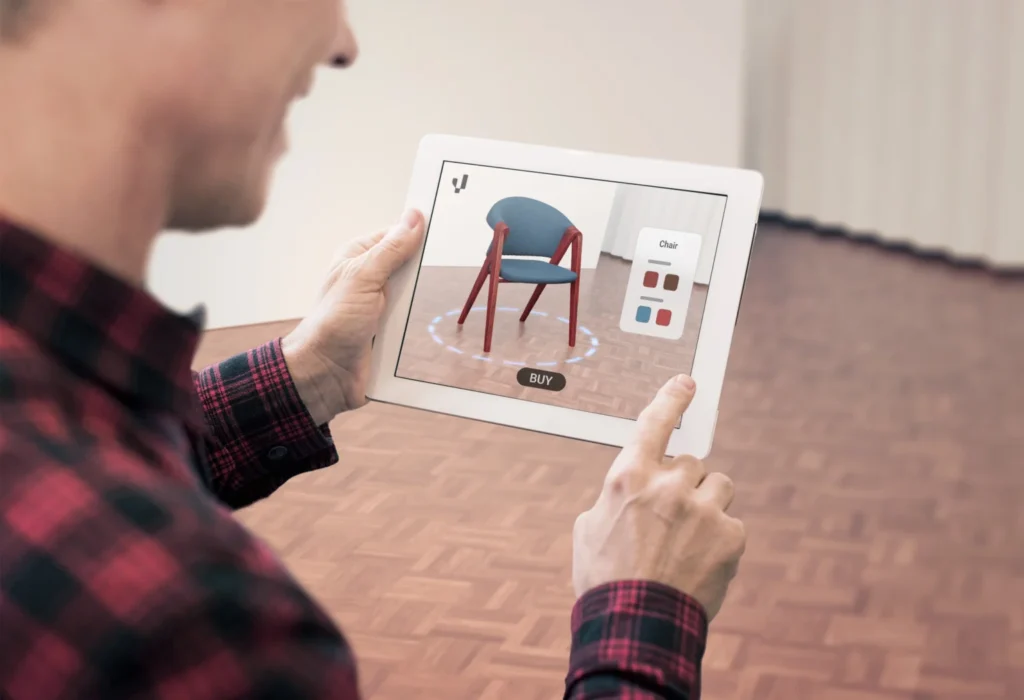
AR for sofas ecommerce helps answer these questions visually by allowing customers to place a true-to-scale sofa or sectional in their own room using a phone camera.
That can improve confidence, increase product page engagement, raise add-to-cart intent, and reduce some fit-related hesitation. It is especially valuable for large-format products where dimensions are difficult to mentally visualize.
AR is not a shortcut for weak PDPs. It works best when models are accurate, load fast, and are paired with strong photography, dimensions, delivery clarity, and trust signals.
What This Guide Covers
This article explains:
- Why ar for sofas and sectionals create unusually high purchase hesitation
- What sofa AR actually does
- Why fit visualization matters more for sofas than many other furniture categories
- Which sofa types benefit most from AR
- AR vs photos vs room-set images vs 360 viewers
Key implementation requirements for sofa AR
- What to measure after launch
- Common mistakes brands make with sectional AR
Why this category is one of the strongest product-type use cases for furniture AR
The Core Problem: Sofa Buyers Struggle to Visualize Fit
Quick answer: Sofas are large, layout-sensitive purchases. Even when dimensions are listed clearly, many shoppers still cannot confidently judge scale inside their own room.
Why this happens:
- Most people do not visualize measurements well
- Product photos often make sofas look smaller or larger than reality
- Room dimensions vary widely
- Sectionals introduce left/right orientation decisions
- Clearance and flow matter as much as wall width
- The buyer cannot test the product physically before checkout
So the customer delays the decision.
They may keep browsing, compare alternatives, take screenshots, send links to family members, or leave the site entirely.
This is why sofa ecommerce often has a confidence gap, not just a traffic gap.
What Is AR for Sofas Ecommerce?
Definition:
AR for sofas ecommerce is a shopping feature that allows customers to place a 3D sofa or sectional model into their real room at true scale using a smartphone camera, so they can evaluate size, orientation, placement, and visual harmony before buying.
In simple terms:
The product page shows the sofa. AR shows the sofa in the customer’s own room.
That difference matters because sofas are not judged in isolation. They are judged relative to:
the room size nearby furniture walking space windows and walls style and color balance
Why Sofas Are One of the Best AR Categories
Direct answer: Sofa buying is highly dependent on room context, which makes AR especially useful.
AR is powerful for sofas because it helps resolve three high-friction questions:
Decision problem Shopper question How AR helps
Scale “Is this too big or too small?” Shows the sofa at true scale in the actual room
Layout fit “Will this block movement?” Helps validate clearance and room flow
Style harmony “Will this look right here?” Lets the shopper judge the sofa in their own décor context
This is why sofas and sectionals are often stronger AR candidates than smaller décor items.
Why Sectionals Create Even More Hesitation
Sectionals introduce more complexity than standard sofas.
Common buyer concerns include:
- left chaise vs right chaise confusion
- L-shape orientation mismatch
- corner placement uncertainty
- overestimating available floor space
- underestimating depth and projection into the room
- difficulty judging proportion relative to rugs, tables, and TV units
Quick answer: The more layout-sensitive the furniture, the more valuable AR becomes.
A shopper may like a sectional on the PDP but still hesitate because the real concern is not aesthetics alone. It is whether the shape will work in the room.
Best Sofa Types for AR
AR can help across many seating products, but it is especially valuable for:
- Standard 3-seater and 4-seater sofas
Why it works:
- strong wall-fit concern easy size comparison against room length common high-traffic SKUs
- Sectional sofas
Why it works:
- orientation matters projection depth matters corner placement creates uncertainty
- Chaise sofas
Why it works:
- customers need to confirm chaise direction the extended side affects walking space and visual balance
- Sleeper sofas
Why it works:
- buyers often care about both closed footprint and usable room space high-consideration purchase with function and fit concerns
- Modular sofas
Why it works:
- multiple configurations create decision complexity customers need help visualizing the chosen arrangement
- Recliner sofas
Why it works:
- buyers often underestimate depth and surrounding clearance needs
Rule of thumb: The bigger the footprint and the more complex the configuration, the more AR matters.
AR vs Photos vs Room-Set Images vs 360° Viewer
Quick answer: Photos help shoppers admire the sofa. AR helps them decide whether it works in their own room.
Photos and 360 viewers still matter. AR is not a replacement for all media. It is the layer that helps resolve the fit question.
What Sofa AR Helps Customers Validate
When used well, sofa AR helps customers answer practical questions such as:
- Does this sofa leave enough walkway space?
- Does the sectional extend too far into the room?
- Is the chaise on the correct side for the room layout?
- Does the back height work under the window or artwork?
- Will the sofa dominate the room visually?
- Does the sofa align properly with the rug, TV, or coffee table?
- Is the room better suited to a 3-seater than an L-shape?
- These are exactly the kinds of questions that often prevent checkout.
How Sofa AR Works in Practice
- Most browser-based sofa AR flows are straightforward:
- The brand uploads an accurate 3D model of the sofa
- The PDP shows a visible Try in Room or View in Your Space button
- The shopper taps the button on mobile
- The phone camera opens
- The room floor is detected
- The sofa appears at true scale
- The shopper moves around and evaluates fit
- The experience should feel fast, obvious, and low-friction.
If the user has to search for AR, wait too long, or guess whether the model is accurate, the conversion benefit drops.
Implementation Requirements for Sofa and Sectional AR
- True-to-scale dimensions
This is non-negotiable. If the scale is wrong, trust drops immediately.
- Correct left/right orientation
For sectionals and chaise models, configuration accuracy matters. Showing the wrong side creates confusion and weakens credibility.
- Optimized 3D models
Heavy models slow down the experience and increase drop-off.
- Strong CTA placement
Put the AR entry point near: product gallery dimensions key purchase actions
Do not bury it low on the page.
- Clear labeling
Examples:
Try in Your Room
View This Sofa in Your Space
See True-to-Scale Fit
- Mobile-first execution
Most AR usage happens on phones, so the experience must be smooth on mobile devices.
What to Measure After Launch
At minimum, track the following:
For sofas, the strongest early signals are usually:
higher AR engagement on high-traffic SKUs stronger add-to-cart rate among AR users more confident product-page behavior
A Simple Pilot Plan for Sofa AR
Goal: Prove whether AR reduces fit hesitation on high-value seating products.
Suggested pilot approach
Step 1: Choose 10–20 hero sofa SKUs
Focus on:
Best-sellers high-margin sofas sectionals with frequent fit hesitation products with strong paid traffic
Step 2: Prioritize layout-sensitive products
Good starting products:
L-shape sectionals chaise sofas deep-seat premium sofas modular units
Step 3: Add visible AR CTA above the fold
Place it near the gallery and dimensions.
Step 4: Route mobile traffic to AR-enabled PDPs
This is especially useful for Meta and Google traffic.
Step 5: Measure weekly
Track AR opens, ATC changes, and buyer feedback.
Step 6: Expand only if the numbers justify it
Do not force full-catalog rollout before you see product-type proof.
Why Sofa AR Pilots Fail
Sofa AR often underperforms for avoidable reasons.
Common failure points
- The model scale is inaccurate
A sofa that looks even slightly off-size damages trust.
- Sectional orientation is wrong
If the left/right chaise is mislabeled or mismatched, buyers lose confidence.
- The AR button is hard to find
If shoppers do not notice it, it cannot influence conversion.
- Models are too slow to load
Performance issues kill intent quickly.
- The PDP is weak overall
AR does not fix missing delivery info, poor reviews, or weak photography.
- No meaningful measurement setup
Without tracking, the team cannot prove lift or optimize rollout.
Quick answer: AR multiplies good commerce execution. It does not rescue poor fundamentals.
Why Sofas Are Different from Smaller Furniture Categories
AR matters more for sofas because the downside of being wrong is higher.
Compare the purchase risk:
Product type Cost of fit mistake AR value
Side table Moderate Medium
Floor lamp Moderate Medium
Rug Moderate Medium–High
Dining table High High
Sofa Very high Very high
Sectional Extremely high Extremely high
A sofa that does not work can force:
room rearrangement return logisticsdisappointment with the whole purchase delayed replacement decisions
That is why sofa AR often makes strategic sense earlier than full-category AR rollout.
Balanced Reality Check
AR for sofas is powerful, but it is not perfect.
It does not fully solve:
cushion comfort uncertainty fabric feel exact color perception under all lighting premium material evaluation delivery and assembly concerns
So brands should present AR honestly:
It helps buyers validate fit and spatial confidence, not every aspect of the product.
- That balanced positioning builds more trust than exaggerated claims.
- Live Examples Readers Can Recognize
- Examples matter because they make the use case intuitive:
- IKEA popularized true-to-scale furniture visualization
- Wayfair-style “View in Room” experiences showed how AR supports furniture browsing
- Amazon’s AR View normalized the idea of placing products in a room before buying
- Shopify’s support for 3D and AR content reinforced the role of immersive media in ecommerce confidence
These examples helped train shoppers to expect richer product evaluation tools.
FAQ
1 Does AR help sell sofas online?
It can, especially when the main shopper hesitation is room fit, scale, or sectional orientation. AR is most useful when it helps customers answer, “Will this actually work in my room?”
2 Is AR more useful for sectionals than regular sofas?
Often yes. Sectionals create more layout uncertainty because orientation, depth, and corner fit matter more than with simpler sofa forms.
3 Can sofa AR reduce returns?
It can help reduce some fit- and size-related mismatches by improving pre-purchase understanding. It does not eliminate all return reasons.
4 Should brands launch sofa AR across the whole catalog?
Usually not on day one. A focused pilot on top sofa and sectional SKUs is easier to measure and optimize.
5 What matters most in sofa AR quality?
Correct scale, correct left/right configuration, fast load times, visible CTA placement, and strong overall PDP execution.